
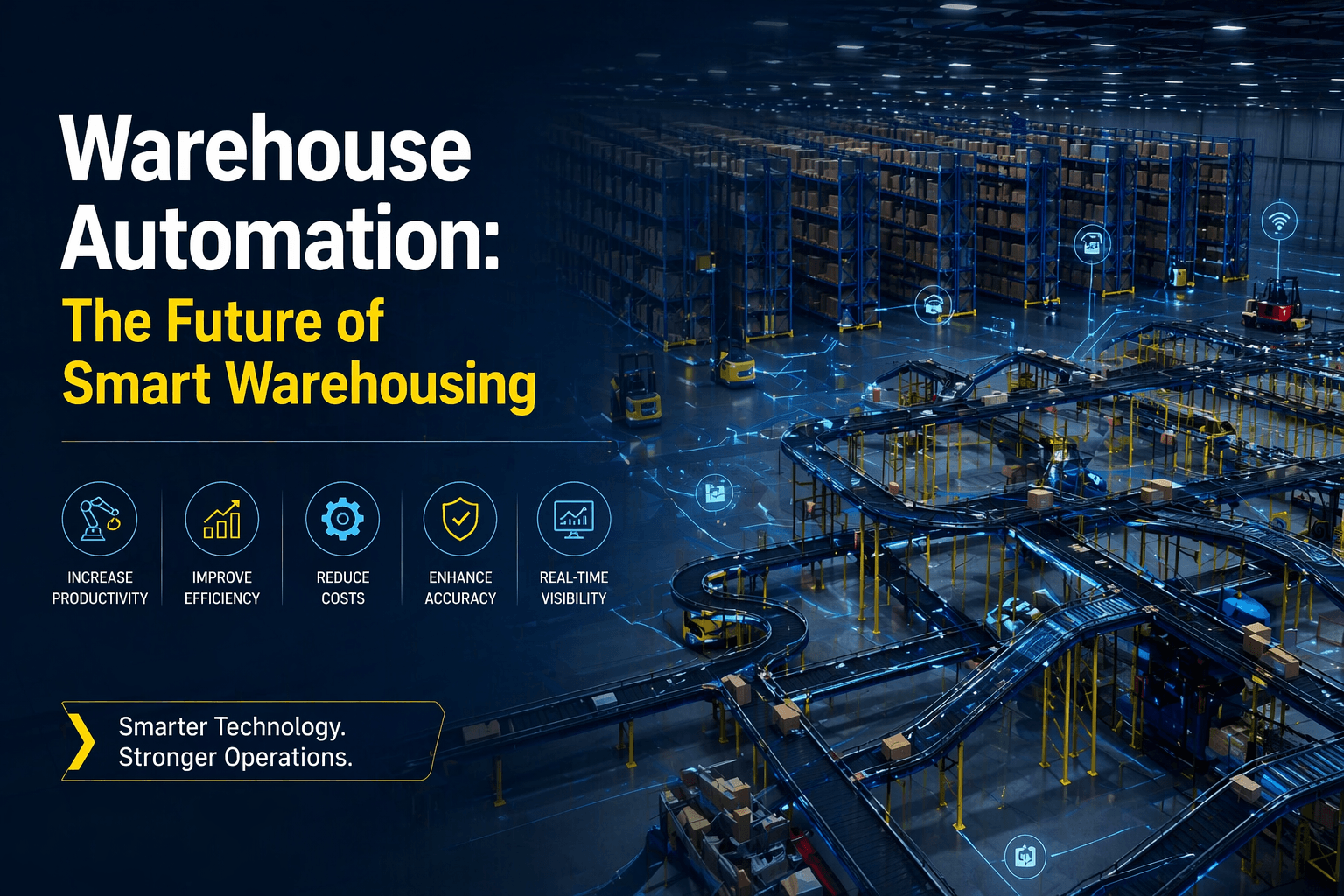
Warehouse Automation: The Future of Smart Warehousing
Introduction
In today’s fast-paced logistics and e-commerce environment, warehouse automation is no longer optional—it’s essential. Businesses are under constant pressure to deliver faster, reduce costs, and handle higher order volumes with accuracy. As a leading warehouse automation provider, Atmos Systems delivers intelligent solutions that transform traditional warehouses into highly efficient automated facilities.
How Does Automation Help in Warehouses?
Warehouse automation uses advanced technologies such as conveyors, robotics, sensors, and software systems to streamline operations.
It helps in:
- Reducing manual labor dependency
- Increasing operational speed
- Minimizing human errors
- Improving inventory accuracy
- Enhancing safety in warehouse operations
Automation ensures smooth material flow from inbound to outbound processes, making warehouses more productive and scalable.
How Long Has Warehouse Automation Existed?
Warehouse automation has been evolving for decades.
- 1960s–1970s: Introduction of basic conveyor systems
- 1980s–1990s: Use of barcode scanning and warehouse management systems (WMS)
- 2000s: Growth of automated storage and retrieval systems (ASRS)
- 2020s: Rise of robotics, AI-driven systems, and smart warehouses
Today, automation is more intelligent, connected, and accessible than ever before.
What Are the Key Drivers in Warehouse Automation?
Several factors are pushing businesses toward automation:
- Rapid growth of e-commerce
- Demand for faster order fulfillment
- Labor shortages and rising labor costs
- Need for real-time inventory visibility
- Increasing warehouse complexity
These drivers are making automation a strategic investment rather than a luxury.
Benefits of Warehouse Automation
Implementing warehouse automation offers multiple advantages:
- Increased Efficiency
Automation speeds up operations and reduces processing time.
- Cost Reduction
Lower dependency on manual labor reduces long-term operational costs.
- Improved Accuracy
Minimizes picking and sorting errors.
- Better Space Utilization
Optimizes warehouse layout and storage capacity.
- Enhanced Safety
Reduces workplace injuries by limiting manual handling.
- Scalability
Easily adapts to business growth and seasonal demand.
Types of Warehouse Automation
- Conveyor Systems
Conveyor systems enable smooth and continuous material flow within the warehouse, reducing manual handling and increasing throughput.
- Robotic Picking
Robotic picking systems use AI and vision technology to identify, pick, and place products accurately, improving speed and precision.
- Automated Sortation
Sortation systems automatically route products based on barcode or RFID data, ensuring fast and accurate order processing.
- Industry-Specific Automation
Customized automation solutions designed for different industries:
- E-commerce: High-speed fulfillment
- Manufacturing: Integrated production lines
- FMCG: Bulk handling systems
- Logistics: End-to-end automation
- Automated Guided Vehicles (AGVs)
AGVs are driverless vehicles that follow predefined paths to transport goods within the warehouse. They are ideal for repetitive material movement tasks.
- Autonomous Mobile Robots (AMRs)
AMRs are advanced robots that navigate dynamically using sensors and AI. Unlike AGVs, they do not require fixed paths and can adapt to changing environments.
- Labeling Systems
Automated labeling systems ensure accurate product identification, barcode generation, and tracking, improving traceability across operations.
- Automated Bagging and Packing
These systems automate packaging processes, ensuring consistent packing quality, reduced labor, and faster dispatch.
Calculating the ROI of Warehouse Automation
Understanding ROI (Return on Investment) is critical before implementing automation.
Key factors to consider:
- Initial investment cost
- Labor cost savings
- Increased throughput
- Reduction in errors and returns
- Maintenance and operational costs
Basic ROI Formula:
ROI = (Net Profit from Automation / Investment Cost) × 100
Example:
If automation saves ₹20 lakhs annually and costs ₹50 lakhs:
ROI = (20 / 50) × 100 = 40% ROI
Most warehouse automation systems achieve ROI within 2–4 years, depending on scale and usage.
Why Choose Atmos Systems as Your Warehouse Automation Provider?
At Atmos Systems, we specialize in delivering end-to-end warehouse automation solutions tailored to your business needs.
Our strengths:
- Customized automation solutions
- Cost-optimized system design
- Advanced conveyor and sortation systems
- Integration with WMS and control systems
- Strong after-sales support
We help businesses transition from manual operations to smart, efficient, and scalable automated warehouses.
Conclusion
Warehouse automation is transforming the way businesses operate. From improving efficiency to reducing costs and enabling scalability, automation is a key driver of modern supply chain success. Partnering with a reliable warehouse automation provider like Atmos Systems ensures that your business stays ahead in a competitive market