
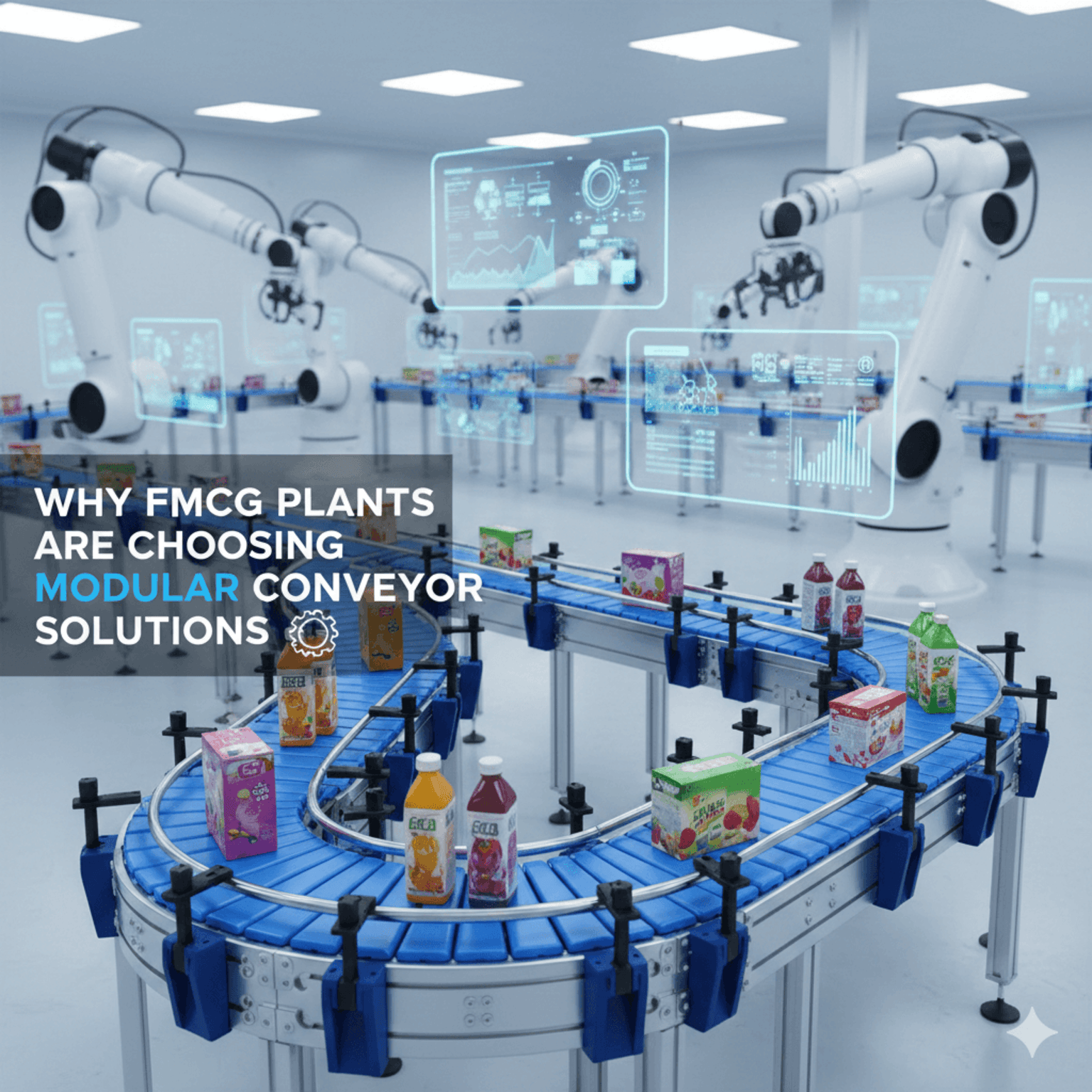
Why FMCG Plants Are Choosing Modular Conveyor Solutions
The Fast-Moving Consumer Goods (FMCG) industry is under constant pressure to deliver high output, maintain hygiene, optimize costs, and respond quickly to fast-changing market demands. Packaging formats are evolving rapidly, SKU counts are rising, and consumer expectations for speed and quality are higher than ever.
To stay competitive, FMCG manufacturers are rethinking their material-handling strategies—leading to a strong industry-wide shift toward modular conveyor solutions. Unlike traditional fixed conveyors, these systems offer flexibility, scalability, and ease of integration with modern automation.
This article explores why FMCG plants across India and globally are choosing modular conveyor systems and how solutions from ATMOS Systems support this next-generation manufacturing approach.
This comprehensive guide examines what differentiates flexible roller conveyors, their advantages, available types, and key features—along with their applications in diverse industrial environments.
1. Flexibility to Handle Frequent SKU and Packaging Changes
FMCG facilities typically deal with:
- Multiple product dimensions
- Seasonal variants
- Rapid line trials
- Frequent packaging redesigns
Traditional fixed lines are not designed for such agility. Modular conveyors—especially Modular Belt Conveyors, Incline/Decline Belt Conveyors, Cleated Belt Conveyors, and portable conveyor systems—enable FMCG plants to reconfigure layouts quickly without major downtime.
Key benefits for FMCG plants:
- Adjustable side guides for varying product sizes
- Quick-change modules for faster setup
- Support for curved, straight, and multi-level movement
- Scalable designs that grow with production demand
This flexibility makes modular conveyors ideal for high-speed, high-variation FMCG environments.
- Robotic pick-and-place operations
- Vision-guided inspection systems
- Automated palletizing
- AMR/AGV-based material movement
Our goal is to ensure zero-interruption workflows and fully coordinated production environments.
2. Faster Installation and Lower Downtime
For FMCG manufacturers, time is money. Production stoppages directly impact revenue, and brands must launch new products faster than ever.
Modular conveyor systems allow:
- Shorter installation cycles due to plug-and-play architecture
- Reduced downtime because damaged modules can be swapped quickly
- Standardized components that simplify maintenance
- Easy operator-level troubleshooting
Whether it’s a belt conveyor system, a motorized conveyor belt, or an automatic conveyor system, modularity ensures faster deployment and uninterrupted performance—critical for plants running 24/7.
3. Enhanced Hygiene & Food Safety Compliance
Food, beverage, and personal care manufacturers demand strict hygiene. Modular conveyors—especially food conveyor systems—are designed with sanitation in mind:
- Smooth, washable surfaces
- Minimal crevices where residue can accumulate
- Tool-less belt removal
- Quick access for cleaning and inspection
- Use of food-grade materials
This makes them ideal for handling biscuits, confectionery, dairy packs, bottles, sachets, and other high-volume FMCG products.
4. Easy Integration with Automation & Robotics
FMCG plants are rapidly adopting automation technologies such as:
- Vision inspection systems
- Pick-and-place robots
- Packing and palletizing systems
- Inline quality check stations
- Conveyor weighing systems
- Automatic sorting and counting units
Modular conveyors integrate seamlessly with these systems. Whether it’s a powered conveyor system feeding a robotic arm or a conveyor weighing system for real-time quality control, modular designs ensure precise synchronization and smooth product flow.
This is essential for plants moving toward Industry 4.0-enabled processing lines.
5. Reduced Operational Costs and Higher ROI
Modular conveyor systems deliver long-term financial benefits:
- Lower installation and modification costs
- Reuse of up to 70–80% of components when redesigning layouts
- Lower maintenance expenses
- Minimal spare parts inventory required
- Optimized manpower utilization
Plants can start with a basic line and expand as production grows, making modular systems extremely cost-effective over time
6. Improved Space Utilization in Crowded FMCG Factories
Plant floor space in FMCG units is always constrained due to high-density machinery, packaging units, and material handling zones.
Modular conveyors help by enabling:
- Tight turning radii
- Vertical movement through incline/decline modules
- Multi-level product routing
- Compact layouts engineered for maximum throughput
Solutions such as truck loading conveyors also reduce loading/unloading time while freeing up warehouse space.
Whether companies search for “conveyor systems near me” or look for tailored material handling systems, modular conveyors offer unmatched adaptability to challenging factory layouts.
7. Scalability to Align with Business Growth
As FMCG brands expand into new geographies or product categories, their conveyor systems must scale without major redesign.
Modular conveyors allow:
- Quick addition of new lines
- Easy speed upgrades
- Integration of sorting and diverter modules
- Expansion into hybrid layouts with belt, modular, and roller systems
Plants can upgrade one section without impacting the entire line—making them future-ready.
Why FMCG Brands Trust ATMOS Systems
ATMOS Systems specializes in delivering future-ready modular conveyor systems engineered for the high-speed demands of the FMCG industry. With a strong focus on reliability, performance, and hygiene, ATMOS provides Indian manufacturers with world-class conveying solutions that are robust, flexible, and designed for long-term value.
ATMOS advantages for FMCG plants:
- Advanced Modular Belt Conveyors, Belt Conveyor Systems, and Cleated Conveyors
- High-quality components sourced from trusted conveyor belt suppliers
- Seamless integration with robotic automation and packaging systems
- Custom-engineered layouts for maximum productivity
- Fast installation, low downtime, and minimal maintenance
- Scalable solutions tailored to your production needs
Whether you require a compact portable conveyor system, a multi-stage Incline/Decline Belt Conveyor, or a full automatic conveyor system, ATMOS Systems ensures best-in-class quality and performance.
Conclusion
FMCG manufacturers are choosing modular conveyor solutions because they bring the agility, scalability, and cost-efficiency needed in today’s fast-evolving market. With faster line changes, better hygiene, seamless automation integration, and reduced downtime, modular conveyors are becoming the industry standard for efficient and future-ready manufacturing.
As demand grows, companies investing in modular conveyor technology will be better equipped to respond quickly, operate efficiently, and stay ahead of market competition.