
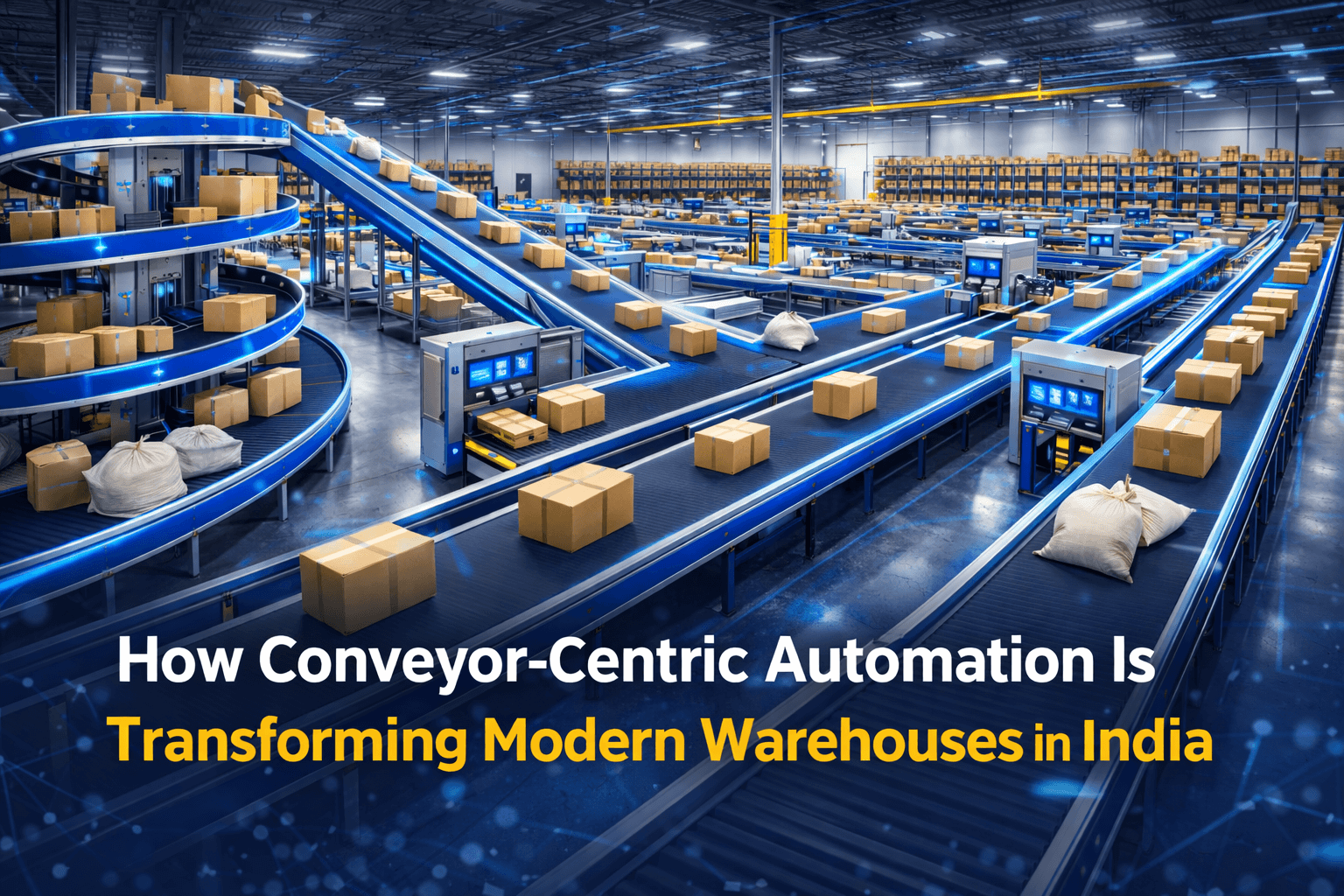
How Conveyor-Centric Automation Is Transforming Modern Warehouses in India
The Indian logistics and warehousing landscape is undergoing a rapid transformation. As e-commerce explodes, 3PL fulfillment accelerates, and customers demand faster delivery cycles, warehouses can no longer rely on manual operations. One technology is emerging as the backbone of modern warehousing: conveyor-centric automation.
From high-speed sortation conveyors to telescopic loading systems and modular conveyor lines, automation powered by conveyors is helping warehouses increase throughput, reduce labor dependency, and operate with greater efficiency and accuracy.
In this blog, we explore why conveyor-centric automation has become essential for Indian warehouses—and how companies like ATMOS Systems are enabling this new era of smart warehousing.
Why Indian Warehouses Are Adopting Conveyor Automation Faster Than Ever
Warehouse automation in India is no longer a luxury—it’s a necessity driven by:
1. Surging E-Commerce & Quick Commerce Volumes
Customers expect same-day or 2-hour delivery, forcing warehouses to process and dispatch orders at unprecedented speed.
2. Labour Shortage & Rising Manpower Costs
Warehouses struggle with workforce availability during peak seasons. Automation reduces reliance on manual labor.
3. Pressure to Reduce Order Errors
Modern warehouse automation systems drastically improve accuracy in sorting, picking, packing, and dispatch.
4. Higher Throughput Needs
Conveyors allow continuous, high-volume movement of goods, unlike manual handling which is slow and inconsistent.
5. The Need for Safety & Ergonomics
Automated conveyor systems lower injury risks and improve worker safety at loading docks and sorting areas.
The Role of Conveyor-Centric Automation in Modern Warehousing
Unlike heavy investments like robots or AS/RS systems, conveyor automation offers the highest ROI with the fastest deployment timeline. Many warehouses begin their automation journey with conveyors because they:
- Reduce travel time within warehouses by 30–60%
- Improve dispatch loading speed by 2–3x
- Enable smooth material movement between processes
- Eliminate manual lifting and pushing
- Increase sorting accuracy and packing speed
- Lower long-term operating costs
Now let’s explore the key conveyor technologies transforming Indian warehouses today.
1. High-Speed Sortation Conveyors: The Heart of E-Commerce & 3PL Warehouses
As parcel volumes soar, manual sortation is becoming nearly impossible. High-speed sortation conveyors help warehouses classify packages quickly into zones, routes, cities, or delivery destinations.
Benefits of Sortation Conveyor Automation:
- Faster order processing
- Reduced manpower needs
- Ultra-high sorting accuracy
- Lower operational cost per parcel
- Ability to scale for peak seasons
E-commerce and express logistics companies rely heavily on these systems to handle thousands of parcels per hour.
2. Telescopic Belt Conveyors: Revolutionizing Loading & Unloading Efficiency
One of the biggest areas of inefficiency in Indian warehouses is truck loading and unloading. Manual loading takes 45–90 minutes on average and causes fatigue, errors, and inconsistent throughput.
Telescopic belt conveyors solve this problem instantly.
How They Transform Operations:
- Reduce loading/unloading time by 50–70%
- Decrease labor dependency
- Improve dock safety and ergonomics
- Enable continuous flow of goods
- Support carton, sack, and package movement
For 3PL, FMCG, retail distribution centers, and e-commerce hubs, telescopic conveyors are becoming a must-have.
3. Modular Conveyors: The Backbone of Flexible Warehouses
Warehouses today must adapt quickly to:
- Seasonal spikes
- SKU changes
- Layout reconfiguration
- Expansion of storage capacity
Modular conveyor systems provide plug-and-play flexibility.
Why Modular Conveyors Are Trending:
- Easy to expand or reconfigure
- Faster installation
- Minimal maintenance
- Lower lifetime ownership cost
- Ideal for MSME and enterprise warehouses
ATMOS Systems offers modular conveyor designs that align perfectly with modern warehouse layouts.
4. Automated Intralogistics Using Roller & Belt Conveyors
The internal movement of goods—from inbound receiving to storage, picking, packing, and dispatch—is the lifeline of any warehouse.
Roller and belt conveyors automate this entire journey.
Applications:
- Movement from receiving dock to inspection zone
- Horizontal/vertical material flow
- Packing & labeling lines
- Sorting & staging areas
- Dispatch conveyor lines
This automation reduces manual lifting, increases accuracy, and improves overall warehouse speed.
5. Smart Warehousing With IoT-Enabled Conveyor Systems
Warehouse automation is shifting from mechanical systems to smart, sensor-based conveyor lines that provide real-time data.
Key Smart Conveyor Features:
- IoT sensors for belt health monitoring
- Vibration & temperature analytics
- Predictive maintenance alerts
- Load monitoring to prevent breakdowns
- Integration with WMS & warehouse control systems
Smart conveyors help warehouses shift from reactive maintenance to predictive maintenance, reducing downtime and repair costs by up to 40%.
6. Integrated Conveyor Lines for End-to-End Warehouse Automation
Modern warehouses are integrating conveyors with:
- Warehouse Management Systems (WMS)
- Barcode & RFID scanners
- Automated weighing systems
- Vision inspection systems
- Printing & labeling machines
- Sortation modules
- Robotic palletizers
This creates a fully connected, semi-automated or fully automated warehouse ecosystem.
7. Conveyor Automation for Different Warehouse Sectors
E-commerce & 3PL Warehouses
- High-speed sortation
- Telescopic loading systems
- Multi-level conveyor structures
FMCG & Retail Distribution Centers
- Case handling conveyors
- Weighing, scanning & packing conveyors
Manufacturing Warehouses
- Pallet handling conveyors
- Assembly-to-warehouse belt systems
Agriculture & Packhouses
- Sorting & grading conveyors
- Bin handling & dispatch conveyors
Each industry benefits differently, but all gain speed, accuracy, and reduced operational cost.
How Conveyor Automation Improves Warehouse KPIs
KPI | Manual Operation | With Conveyor Automation |
Loading/Unloading Time | 45–90 min | 15–25 min |
Sorting Accuracy | 80–90% | 99%+ |
Throughput | Limited | 2–5x higher |
Labour Dependency | Very high | 40–60% lower |
Order Fulfillment Speed | Slow | Fast & continuous |
Operational Cost | High | Optimized |
Automation directly improves warehouse profitability and performance.
ATMOS Systems: Delivering Conveyor-Centric Warehouse Automation
ATMOS Systems is helping Indian warehouses upgrade to efficient, scalable, and future-ready intralogistics through:
✔ High-speed sortation conveyors
✔ Telescopic loading conveyors
✔ Modular belt & roller conveyors
✔ IoT-enabled smart conveyors
✔ Automated weighing & scanning lines
✔ Integrated dispatch conveyor systems
✔ Tailored conveyor automation for 3PL, FMCG, retail & manufacturing
Our systems are designed for high throughput, durability, low maintenance, and maximum ROI, making them ideal for India’s fast-evolving warehousing sector.
Conclusion: Conveyor-Centric Automation Is the Future of Indian Warehousing
As India’s supply chain grows more demanding, conveyor systems are emerging as the most cost-effective, scalable, and high-impact automation investment.
With conveyor-centric automation, warehouses can achieve:
- Faster order fulfillment
- Lower labor dependency
- Reduced operational cost
- Higher accuracy & productivity
- Scalable, flexible layouts
- Improved safety & ergonomics
For Indian warehouses aiming for global standards, conveyor automation is not just beneficial—it is essential.