
Gravity Conveyor vs Powered Conveyor: Choosing the Right Conveyor System for Efficient Material Handling
In modern warehouses, manufacturing plants, and distribution centers, conveyor systems are the backbone of efficient material handling operations. Businesses rely on conveyors to move products quickly, reduce manual labor, and improve operational productivity.
Among the most widely used conveyor technologies are Gravity Conveyors and Powered Conveyor Systems. Both solutions are designed to transport goods across different stages of production, packaging, and logistics operations, but they operate in very different ways.
Choosing the right conveyor system is essential for improving warehouse efficiency, reducing operational costs, and optimizing workflow automation.
In this blog, we will explore the key differences between gravity conveyors and powered conveyors, their working principles, advantages, and ideal industrial applications to help businesses make informed decisions.
What Is a Gravity Conveyor?
A gravity conveyor system is a type of material handling equipment that moves products using gravity or manual force instead of electrical power. These conveyors typically consist of rollers, skate wheels, or tracks mounted on a frame, allowing cartons, boxes, or packages to move smoothly when pushed manually or placed on a slight incline. Gravity conveyors are widely used in warehouses, distribution centers, assembly lines, and packaging stations where simple and cost-effective product movement is required.
Common Types of Gravity Conveyor Systems :-
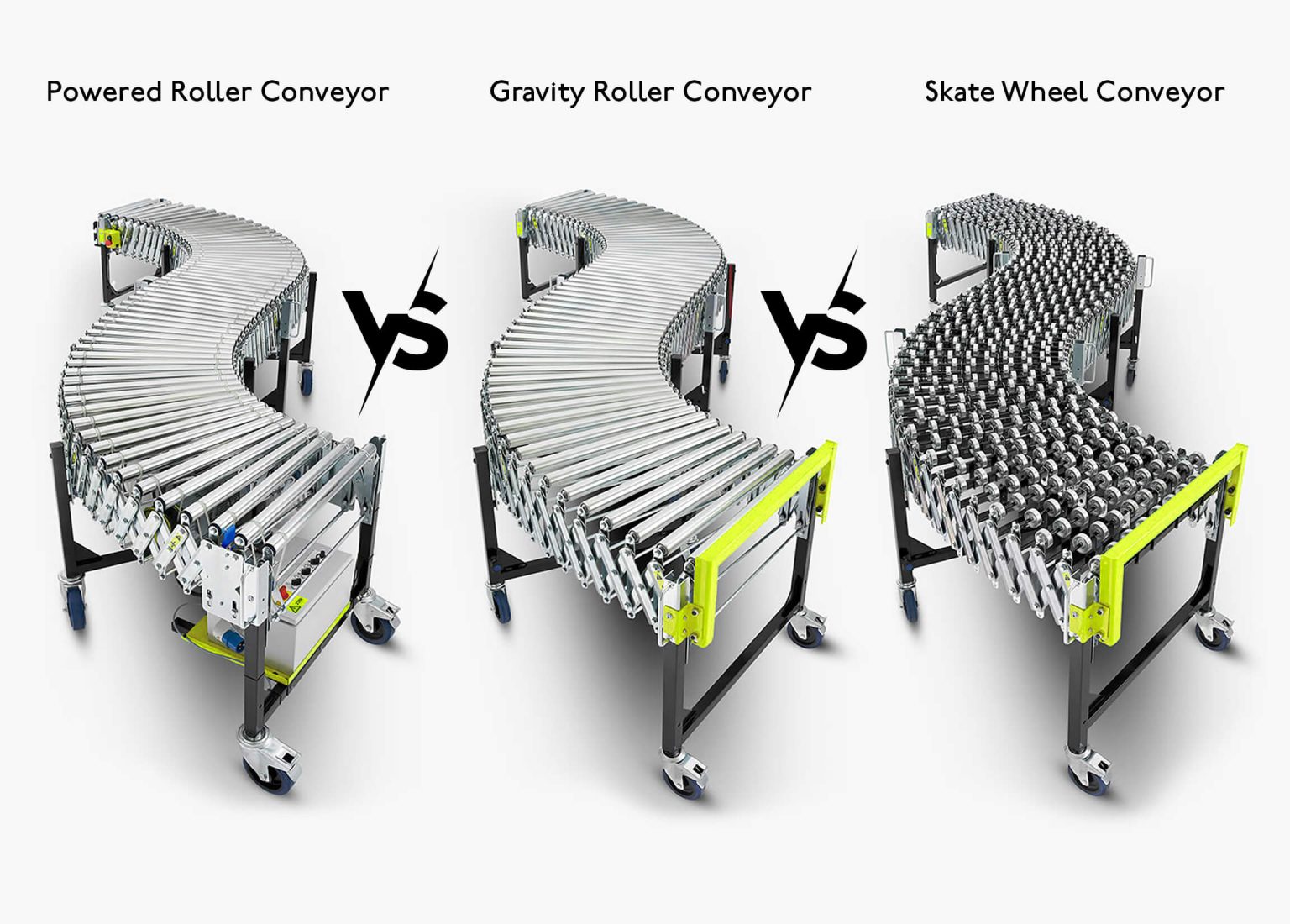
Gravity Roller Conveyor
A gravity roller conveyor uses cylindrical rollers to transport cartons and packages smoothly across short distances. It is one of the most common conveyor systems used in warehouses.
Skate Wheel Conveyor
A skate wheel conveyor uses multiple small wheels to move lightweight packages and cartons efficiently, especially in sorting and packing operations.
Flexible Gravity Conveyor
Flexible gravity conveyors are expandable and portable, making them ideal for dynamic warehouse layouts and temporary material handling setups.
Advantages of Gravity Conveyor Systems
Cost-Effective Material Handling Solution
Gravity conveyors are one of the most economical conveyor systems available, as they do not require motors, electrical panels, or complex automation components.
Low Maintenance Requirements
Since gravity conveyors have fewer moving parts, they require minimal maintenance compared to powered conveyor systems.
Energy Efficient Operation
Gravity conveyors operate without electricity, making them an energy-efficient and environmentally friendly conveyor solution.
Flexible Warehouse Integration
These conveyors can be easily relocated, expanded, or adjusted, making them suitable for warehouses that frequently change their layout.
Limitations of Gravity Conveyor Systems
While gravity conveyors offer many benefits, they also have certain limitations: Limited control over product speed
• Not suitable for long-distance transportation
• Requires manual intervention for product movement
• Difficult to integrate with advanced automation systems
For facilities that require continuous product flow, high throughput, or automated operations, powered conveyor systems are often a better choice.
What Is a Powered Conveyor System?
Belt Conveyor System
A belt conveyor system uses a continuous belt driven by a motor to transport materials smoothly across different stages of production or warehouse operations. Belt conveyors are widely used in industries such as FMCG, automotive, packaging, and food processing.
Powered Roller Conveyor
A powered roller conveyor uses motor-driven rollers to move cartons, boxes, and pallets with controlled speed and efficiency. These conveyors are commonly used in sortation systems and distribution centers.
Modular Belt Conveyor
A modular belt conveyor system uses interlocking plastic modules instead of a continuous belt. These conveyors are commonly used in food conveyor systems and hygiene-sensitive industries.
Incline and Decline Belt Conveyor
Incline conveyors allow products to move between different levels of a warehouse or production facility, improving vertical space utilization.
Benefits of Powered Conveyor Systems
High Throughput and Productivity
Powered conveyors enable continuous product movement, allowing facilities to handle high volumes efficiently.
Suitable for Long-Distance Transportation
Unlike gravity conveyors, powered conveyor systems can transport products over long distances without manual intervention.
Controlled Product Flow
Powered systems provide speed control and automation capabilities, reducing product damage and improving operational accuracy.
Easy Integration with Warehouse Automation
Powered conveyors can integrate seamlessly with: Warehouse automation systems
• Barcode scanners
• Sorting systems
• Robotics and AMR solutions
• Conveyor weighing systems
This makes them essential for modern smart warehouses and automated distribution centers.
Gravity Conveyor vs Powered Conveyor: Key Differences
|
Feature |
Gravity Conveyor |
Powered Conveyor |
|
Power Source |
Gravity or manual push |
Electric motor |
|
Automation Level |
Manual or semi-manual |
Fully automated |
|
Initial Cost |
Low investment |
Higher investment |
|
Maintenance |
Minimal |
Moderate |
|
Product Flow Control |
Limited |
Advanced control |
|
Suitable For |
Small operations |
Large automated facilities |
When Should You Use Gravity Conveyors?
Gravity conveyors are best suited for: Packing and sorting stations
• Short-distance product movement
• Small warehouses or manual operations
• Budget-friendly material handling setups
They are commonly used in loading docks, packaging lines, and manual sorting areas.
When Should You Use Powered Conveyor Systems?
Powered conveyor systems are ideal for: Large warehouses and distribution centers
• High-volume manufacturing plants
• Automated logistics operations
• E-commerce fulfillment centers
These systems are designed to increase operational efficiency, improve material flow, and support warehouse automation strategies.
Hybrid Conveyor Systems in Modern Warehouses
Many modern warehouses use a combination of gravity and powered conveyors to maximize efficiency.
For example: Gravity conveyors in packing areas
• Powered conveyors in main transport lines
• Automated sortation conveyors for order routing
This hybrid approach helps businesses reduce operational costs while maintaining high productivity and automation levels.
Conveyor Solutions by ATMOS Systems
At ATMOS Systems, we specialize in designing advanced conveyor systems and warehouse automation solutions for modern industrial environments. Our solutions are engineered to improve efficiency, reliability, and operational performance across manufacturing and logistics operations.
Our conveyor portfolio includes: Belt Conveyor Systems
• Gravity Roller Conveyors
• Modular Belt Conveyors
• Powered Roller Conveyor Systems
• Flexible Conveyor Systems
• Truck Loading Conveyors
• Conveyor Weighing Systems
• Automatic Conveyor Systems
With a focus on innovation, durability, and cost optimization, ATMOS Systems helps businesses build high-performance material handling infrastructure for the future.
Conclusion
Both gravity conveyors and powered conveyor systems play a vital role in modern material handling operations. Gravity conveyors offer simplicity, affordability, and energy efficiency, making them ideal for small-scale operations. On the other hand, powered conveyors provide automation, speed control, and high throughput, which are essential for large warehouses and manufacturing plants. Choosing the right conveyor solution depends on product volume, warehouse layout, automation requirements, and operational goals. By implementing the right conveyor technology, businesses can optimize workflow, reduce manual handling, and significantly improve productivity.