
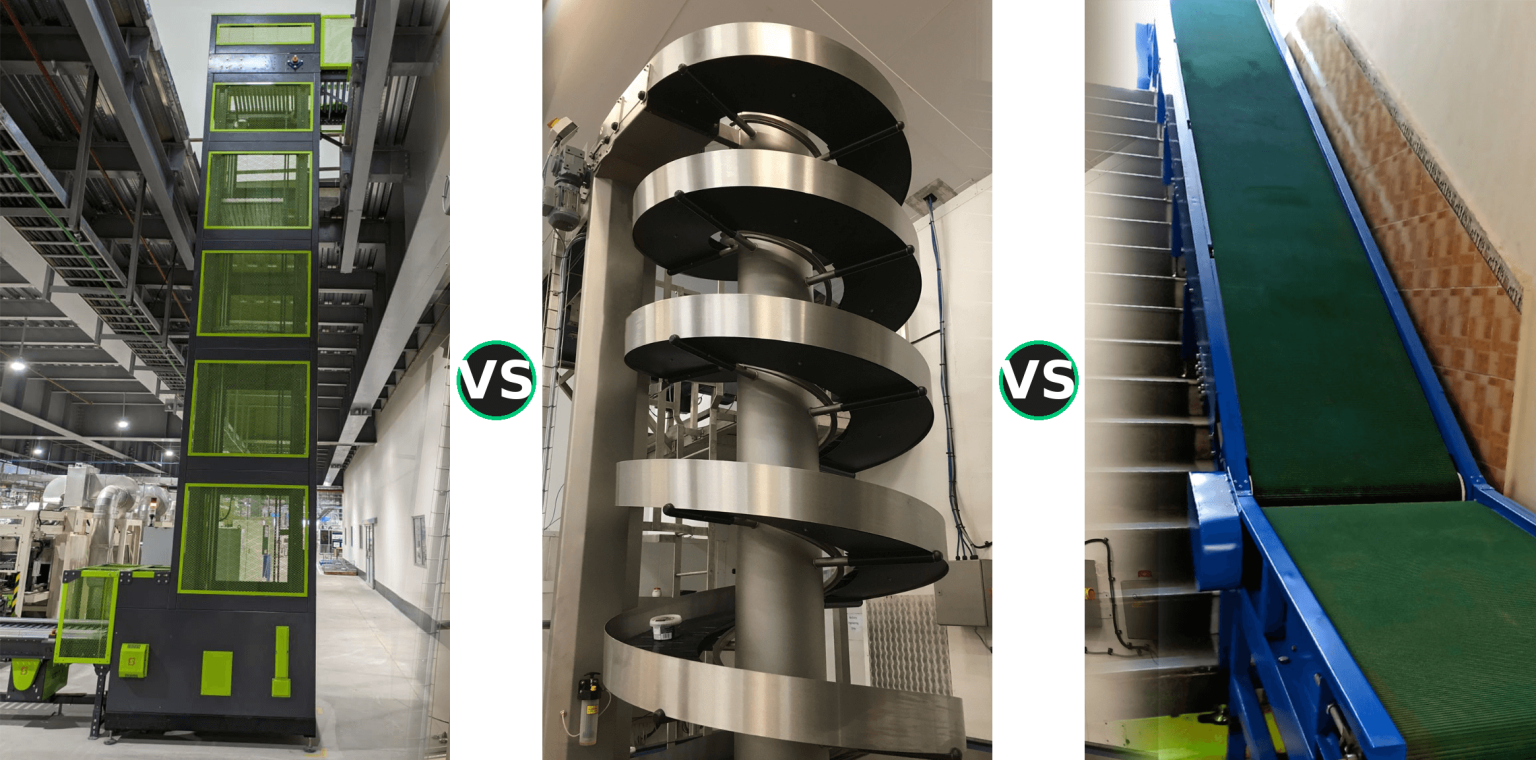
Vertical Conveyor vs Spiral Conveyor vs Incline Conveyor: Choosing the Right System for Modern Warehouses
In today’s rapidly evolving logistics and manufacturing environments, warehouses are no longer limited to single-level operations. Rising land costs, higher storage demand, and the growth of e-commerce have pushed companies toward multi-level warehouses, mezzanine systems, and vertical storage solutions.
However, expanding vertically introduces a critical operational challenge: How to move materials efficiently between different levels of a facility.To solve this challenge, companies rely on specialized conveyor systems designed for vertical material movement.
The three most commonly used solutions include :-
Each conveyor type serves a specific purpose and offers unique advantages depending on the warehouse layout, product characteristics, throughput requirements, and available floor space. This guide explains the differences between vertical conveyors, incline conveyors, and spiral conveyors, helping businesses select the most efficient system for their warehouse automation strategy.
The Growing Need for Vertical Material Handling in Warehouses
Modern warehouses are becoming more complex due to increased order volumes and SKU diversity. To maximize storage capacity and operational efficiency, many facilities now incorporate:
- Multi-tier storage systems
- Mezzanine floors
- Automated distribution centers
- High-density warehouse layouts
While these designs significantly improve storage capacity, they also require reliable systems to move goods between different levels quickly and safely.
Traditional methods such as forklifts, lifts, and manual handling often create operational challenges, including:
- Slower material movement
- Higher labor dependency
- Increased safety risks
- Operational bottlenecks
To overcome these limitations, warehouses are increasingly adopting automated conveyor systems for vertical transportation.
What Is a Vertical Conveyor System?
A vertical conveyor system is designed to transport materials directly upward or downward between different floors or levels within a facility. These conveyors typically operate using lifting platforms or reciprocating mechanisms that move products vertically. Vertical conveyors are widely used in industries where space is limited but vertical movement is essential.
Typical Applications
Vertical conveyors are commonly installed in:
- E-commerce fulfillment centers
- FMCG distribution warehouses
- Manufacturing facilities
- Pharmaceutical and packaging plants
- Automated storage systems
They are particularly useful for moving cartons, crates, totes, and containers between multiple floors.
Advantages of Vertical Conveyor Systems
- Space Optimization
Vertical conveyors occupy minimal floor space, making them ideal for facilities with limited horizontal room. - High Load Handling Capability
These systems can handle heavier loads compared to many inclined conveyors. - Controlled and Stable Movement
Products are lifted vertically in a stable and controlled manner. - Suitable for Multi-Floor Warehouses
Vertical conveyors provide reliable transport between clearly separated floors.
Limitations
Vertical conveyors typically operate in batch mode rather than continuous flow, which may reduce throughput in high-volume logistics environments.
What Is an Incline Conveyor System?
An Incline conveyor system transports materials between different elevations using a sloped conveyor path. Instead of lifting products vertically, the conveyor moves them gradually upward or downward along an inclined surface.
Incline conveyors are among the most commonly used material handling conveyors in warehouses and manufacturing facilities. Common Types of Incline Conveyors.
Incline conveyors may use different technologies, including :-
- Belt conveyor systems
- Cleated belt conveyors
- Modular belt conveyors
- Powered roller conveyors
These systems are widely used for transporting cartons, bags, parcels, food products, and lightweight industrial components.
Advantages of Incline Conveyor Systems :-
- Continuous Material Flow
Incline conveyors enable uninterrupted product movement, improving operational efficiency. - Higher Throughput
Compared to vertical lifts, incline conveyors support faster processing rates. - Versatile Applications
They can handle a wide variety of product types and packaging formats. - Cost-Effective Automation Solution
Incline conveyors are generally simpler and more economical than more complex lifting systems.
Limitations
Because they operate on a slope, incline conveyors require more horizontal floor space than vertical conveyors.
What Is a Spiral Conveyor System?
A Spiral conveyor system moves materials vertically using a spiral-shaped path, allowing products to travel upward or downward while maintaining continuous movement.
Spiral conveyors are widely used in high-throughput logistics environments where vertical transportation must be combined with efficient space utilization.
Typical Applications
Spiral conveyors are commonly used in:
- E-commerce distribution centers
- Airport baggage handling systems
- Food and beverage production lines
- Automated packaging facilities
- High-volume sorting centers
These systems are particularly valuable when warehouses need continuous vertical movement without occupying large floor areas.
Advantages of Spiral Conveyor Systems :-
- Continuous Vertical Transportation
Unlike vertical lifts, spiral conveyors maintain a continuous flow of products. - Efficient Use of Space
They require less floor space than incline conveyors. - High Throughput Capacity
Spiral conveyors are capable of handling large volumes of packages per hour. - Energy Efficiency
Modern spiral conveyor systems are designed to minimize power consumption.
Limitations
Spiral conveyors generally require higher initial investment and more complex installation compared to incline conveyors.
Vertical Conveyor vs Incline Conveyor vs Spiral Conveyor
The choice between these conveyor systems depends on operational requirements and warehouse layout.
Feature | Vertical Conveyor | Incline Conveyor | Spiral Conveyor |
Movement Direction | Straight vertical lift | Sloped transport | Spiral vertical transport |
Material Flow | Batch movement | Continuous flow | Continuous flow |
Space Requirement | Very compact | Requires longer floor space | Compact vertical footprint |
Throughput Capacity | Moderate | High | Very high |
Load Handling | High | Medium | Medium |
Installation Cost | Medium | Lower | Higher |
Ideal Use Case | Multi-floor lifting | Mezzanine material movement | High-speed automated warehouses |
Selecting the Right Conveyor for Your Warehouse
Choosing the appropriate conveyor system requires evaluating several operational factors.
Choose a Vertical Conveyor When
- Floor space is limited
- Products need direct vertical lifting
- Heavy loads must be transported
- The warehouse operates across multiple floors
Choose an Incline Conveyor When
- Continuous product flow is required
- Floor space is available for a sloped conveyor path
- Products are lightweight or medium weight
- A cost-effective automation solution is required
Choose a Spiral Conveyor When
- High throughput is essential
- Space optimization is important
- Continuous vertical movement is required
- The warehouse operates high-volume sorting or fulfillment systems
In many modern facilities, the most efficient solution involves combining multiple conveyor technologies to create a fully optimized material flow system.
How Conveyor Automation Improves Warehouse Efficiency
Integrating the right conveyor technology can significantly enhance warehouse performance by:
- Increasing throughput and processing speed
- Reducing manual handling requirements
- Improving workplace safety
- Optimizing available warehouse space
- Lowering operational costs
- Enabling integration with warehouse automation systems
These benefits make conveyor automation a critical component of modern intralogistics and warehouse management strategies.
ATMOS Systems: Advanced Conveyor Solutions for Modern Material Handling
ATMOS Systems specializes in designing and manufacturing high-performance conveyor systems for warehouse automation and industrial material handling.
Our solutions include:
- Belt Conveyor Systems
- Modular Conveyor Systems
- Incline and Decline Conveyors
- Spiral Conveyors
- Vertical Conveyors
- Telescopic Belt Conveyors
- Sorting Conveyor Systems
- Truck Loading Conveyors
Each system is engineered to deliver reliable performance, high efficiency, and seamless integration with modern warehouse automation technologies.
ATMOS Systems supports industries such as FMCG, logistics, e-commerce, manufacturing, agriculture, and retail distribution, helping businesses improve operational efficiency and scale their material handling capabilities.
Conclusion
As warehouses become more advanced and space optimization becomes critical, businesses must adopt the right vertical material handling systems.
Each conveyor technology plays a distinct role:
- Vertical conveyors provide compact solutions for lifting products between floors.
- Incline conveyors offer efficient and cost-effective continuous material movement.
- Spiral conveyors enable high-throughput vertical transportation in limited space.
Selecting the appropriate system—or a combination of systems—can significantly improve warehouse productivity, operational efficiency, and automation readiness.
For organizations planning to upgrade their material handling infrastructure, investing in the right conveyor technology is essential for building a future-ready warehouse environment.